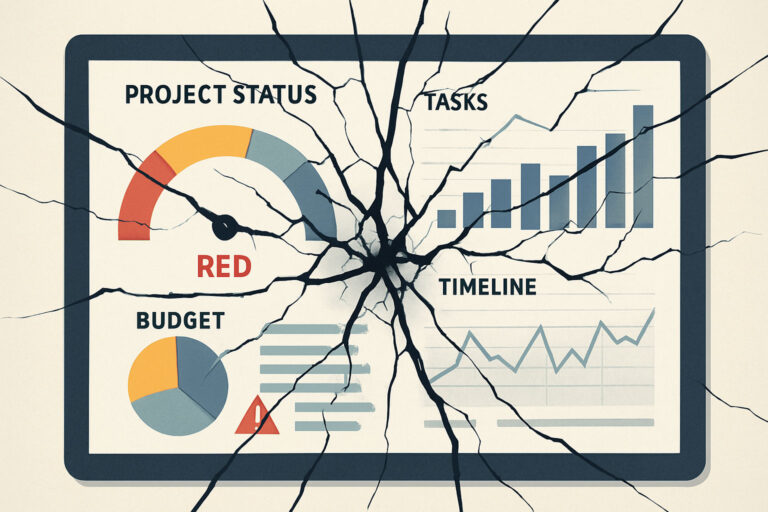
Everyone seems to always agree that government reform is needed to keep up with a more efficient, digital world. And yet those government reform efforts always generate failure signals that are ignored time and again.
And yet so many land with a thud – and we throw our hands up all over again.
We point to risk registers and claim we covered every angle – but if the government reform is still a failure, then how can we say that we did everything right?
Below are five government reform failure signals that should be ignored at your own peril.
1. Prioritizing speed over thoughtful execution
If there’s one thing that a lot of government initiatives lack, it’s urgency. Too many projects and reform activities are given a broad timeline, and people settle in for the long haul. Inevitably, Parkinson’s Law takes hold: to paraphrase, a task will swell to accommodate the time that it’s given – so if you’re given a year, you’ll take a year, even if it could be done in a couple of times.
Having said that, the other extreme can be a government reform’s undoing as well.
We’ve seen this play out in the early days of Elon Musk’s DOGE work, where cuts were both inflated and were made to programs that had already ended, and spending was ridiculed, even when it was misidentified.
Most citizens are happy to see waste eliminated, but sometimes we have to pause before we “push the button.”
2. Applying Solutions Without Diagnosing the Problem
We’ve come to expect miracles from software – after all, most people’s entire lives are wrapped up in their phones, and who doesn’t use an app to manage almost every aspect of their lives?
But now imagine one app managing how every single person shops for their groceries, including everyone’s driving directions and dietary needs.
How could an app gather all of that information by itself and make it uniform?
That’s the massive challenge facing any department or agency that tries to “transform” by delegating all of the work to software systems. The fact is, there could be dozens or even hundreds of different processes underlying each output, even if different departments are producing the same outputs, there is an almost 100 percent chance that they have differences in how they deliver.
Assuming that software can figure all of that out and make things whole is a pipe dream.
Standardize the processes first, then align the software to that.
3. Ignoring Stakeholder Feedback
DOGE making loads of mistakes and only finding out afterwards
It’s become a pretty standard playbook at this point: a new “voice” comes in and promises change – because the person before them had made such a mess of things.
But this new person is the one with all of the answers. And because they have all of the answers, they certainly don’t need to listen to anyone who’s been around before them, right?
This has all been playing out in real-time recently with Elon Musk’s appointment to lead the DOGE initiative (department? agency?) and slash government waste.
It’s a great idea, and I would welcome this type of urgent transformation from an advisory standpoint. But we’ve seen how many problems can arise if that great new external insight is put into action without consulting those in the know: cost savings that had already disappeared, misidentified and mislabelled expenses, and court orders blocking actions because of undetermined legality.
Outside perspectives are excellent and always needed.
Insider know-how will help fill out the picture.
5. Overcomplicating processes to “fix” inefficiencies
Sometimes, government’s desire to keep things objective and impartial protect the public’s interest against cronyism, favoritism, and exploitation.
Sometimes, though, it leads the public service down a beaten path that takes them miles from the intended destination.
A number of years ago, the new head of the department I was in at the time decided to launch an innovation competition. He wanted fresh ideas, and he was emphatic: he didn’t care where they came from or what kind of hierarchy laid between him and the ideator, he just wanted creative solutions.
He then delegated it senior leaders, and the public service did what the public service does: it created an Innovation Committee to evaluate the proposals.
And proposals couldn’t be evaluated without evaluation criteria, could they? And how could they evaluate ideas against criteria unless those criteria were first sub-divided into categories? And how could they evaluate ideas within the categories unless the ideas were first pre-identified by category, ideally by the people submitting the innovations?
And so three-page forms were developed, and it was mandatory for any idea-generator to first fill out that form – and have it endorsed by their manager.
This upfront burden filtered out most ideas from the get-go: in a department of roughly 2,000 employees, a full nine people actually submitted ideas.
Of those nine that were evaluated, a grand total of zero were deemed to be worthy of recommending to the department head.
An overcomplicated process made a nimble call-out into a bureaucratic graveyard.
6. Disregarding the human element of change
A number of years ago, I joined a team that was charged with overseeing back-office transformation across the entire federal government. A number of major initiatives were already underway – including the Phoenix catastrophe – and it became clear that they would ultimately be medium-term solutions at best.
Dramatic, long-term changes were needed.
And it was going to cost a whole lot of money.
Everyone always talks about how cautious and unambitious the public service is, but this team would have opened a few eyes. We developed unconventional ideas and imagined ideal states of government operations, tied neither to current nor to expected operational models.
It was to be completely new, modern, and efficient.
And the biggest surprise of all?
Senior management seemed to love it.
At each stage of the development, we received green light after green light. Conversations were positive and encouraging.
Until those conversations led to implications on the workforce.
Making the processes more automated necessarily meant that there would be job losses, which would be contested by the unions. Making matters worse, most of the job losses would be in sensitively-seen demographics, which could have led to negative headlines.
And all of this took place under a government that wanted to expand public services, not reduce them.
We never received a formal “no” to anything. But time after time, we were asked to “take another look” at this or that, and to keep “checking in.” The aggressive timelines became conservative – then became perpetual. Unceremoniously, eventually everyone all just decided to move onto something else.
Great ideas that were championed at the highest levels went into the innovation graveyard.
Because we hadn’t considered the interests of the people whose endorsement it required.
Government Reform Failure Signals Hide In Plain Sight
We too often default to the easiest risks for our projects – the ones that have been around forever, and that were identified by lots of people before us.
But it’s the unspoken problems that can more often haunt us. The risks that we want to avoid – like what if they say “no?” – to the risks that we don’t want to dive into – such as, “what if each department takes tiny little steps that are different from each other?”
Each project requires open, honest conversations about the real failure signals hiding in plain sight.
Because if we pretend that our project has the same risks as any other project, then it will inevitably become just any other failure.
👇 Want to Uncover Your Own Blind Spots?
If you’re navigating tricky project waters in the public sector, the Project Health Check could help you to detect exactly what’s going wrong. It takes five minutes, and it might catch the exact government reform failure signals that trip up so many public sector projects.
You can also learn more about my services here, or explore more real-world insights in the Insights section.